
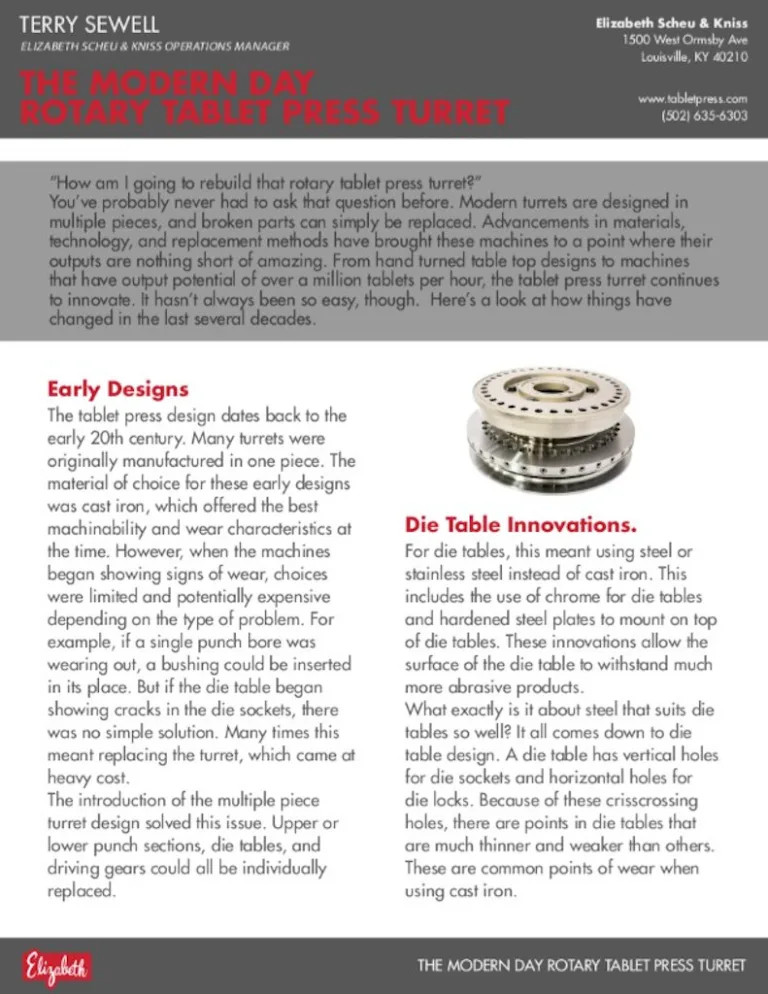
The Modern Day Rotary Tablet Press Turret
"How am I going to rebuild that rotary tablet press turret?" You've probably never had to ask that question before. Modern turrets are designed in multiple pieces, and broken parts can simply be replaced. Advancements in materials, technology, and replacement methods have brought these machines to a point where their outputs are nothing short of amazing. From hand turned table top designs to machines that have output potential of over a million tablets per hour, the tablet press turret continues to innovate. It hasn't always been so easy, though. Here's a look at how things have changed in the last several decades. Download to read more.

Multi-Layer & Core Tabletting Innovation
The growth of high-potency and combination drug products over the last decade has made multi-layer and core tablets a hot topic. In fact, these novel delivery systems have been essential not only in formulating new products but also in helping pharmaceutical companies extend patents. They have also enabled nutraceutical and confectionery companies to innovate, either by developing new products or modifying existing brands for a market advantage. Download to read more.

Punch & Die Alignment
In the tableting industry, manufacturers using the rotary tablet press rely on industry specifications for punches and dies outlined in the Tableting Specification Manual. While this manual is a very good resource for tooling, it does not provide specifications for the tablet press turret, which houses the punches and dies. This article is meant to address some of the issues faced by tablet manufacturers with reference to how the turret specifications relate to tooling fit and tooling life. Download to read more.

Tool Polishing Procedures
We, at Elizabeth Carbide, recommend only polishing when necessary to avoid unwanted blending or reducing of any embossing. Always inspect the important dimensions of the punch (tip size, working length etc.) both before and after the polishing is done to insure the punches to be in good working condition. Download to read more.

Born To Be Manufactured
Tablets are the preferred dosage form for both patients and drug manufacturers; the tableting process is well established and cost-effective, but the science and engineering go deeper than you expect. A number of aspects must be considered to design a tablet that is well suited for commercial manufacture. Download to read more.

Accounting for Differences in TSM & EU Tooling
As a tooling vendor, weʼre asked if TSM specification tooling for “B” and “D” type tooling is interchangeable with EU or Euro tooling specifications based on the ISO 18084:2011 standards. Based on the provided information weʼll consider differences in tool specifications and other factors that may affect compression or matching results when a set of tooling was manufactured to TSM and the other to ISO 18084 specification standards. Download to read more.